

A few weeks ago my mother told me a story about her father that I had never heard.
I was young when my grandfather died. I was old enough to remember him, but too young to be told much about his life. He had always intended to travel, and he had decided the travelling would wait until he retired. After he retired, he was diagnosed with cancer, and he died suddenly.
His passports arrived in the mail in the days between his death and his funeral.
Those passports are a plain fact, but they also stand for something larger: a plan that was real and ready, and that arrived too late to be used. My grandfather’s delay was not careless. Waiting until retirement is what sensible people of his generation did. He worked hard, provided for his family, and earned the opportunity to travel in his retirement. The sensibleness of his choice is what makes the story so hard to dismiss.
My grandmother drew her own conclusion from it. She bought each of her five children, my mother among them, a timeshare holiday. She was not going to watch them make the same mistake.
Cancer is not an abstraction in my family. It took both my grandfathers, and both of my parents have had it since. Hearing the passport story now, at this point in my own life, landed differently than it would have at ten.

Two reactions
The story produced two reactions in me. The first was gratitude for what I have right now: the people around me, my health, the life we have built. The second was resistance to a habit I recognise in myself, which is leaning into the future and saving the good things for a later that is assumed to arrive.
The obvious lesson is to stop waiting and live now. To do all the things that I have wanted to do in case that later never arrives. But that lesson is too simple, and I don’t think it’s right.
I live in Australia, where house prices have run so far ahead of wages that many young people will struggle to buy a home without help from their parents. I want to be able to give my kids that help. Spending everything now would not honour my grandfather’s story. It would be a different mistake, and my children would be the ones paying for it.
So the real question isn’t whether to live now or provide for later. Both matter, and we will face this choice again and again, not just once. What is needed is a principle that tells us, case by case, which one should govern, so we’re not relying on instinct or mood each time the choice comes up.
What we regret, and when
Research on regret helps answer that question. In the 1990s, the psychologists Thomas Gilovich and Victoria Medvec studied what people regret, and found that the answer depends on how far back a person is looking1. When people thought about recent regrets, they more often named something they had done. When they thought about the regrets of their whole life, they more often named something they had not done: the course never started, the friend never called, the trip never taken.
Part of the explanation is what we do with each kind of regret. When we regret something we did, we usually act on it. We apologise, we repair the damage, or we find the lesson in it and make it part of our story. But a regret about something we never did gives us nothing to repair. It stays as it was.
This matches a belief I have held for a long time. A life well lived is not a life without regret. It is a life where, looking back, most of the regrets are for things I did. Regrets of that kind mean I tried something. The other kind means I never found out.
The adviser in my head
Last year I put that belief to the test. I took the year off work, and my partner and I travelled with our kids: Europe, South-East Asia, and South America, including a five-day hike to Machu Picchu. We were frugal. We paid for the flights using flyer points we had saved for years, but we paid for it mostly with money that had been sitting against our mortgage. Using that money means the house will take longer to pay off.
There is a version of my financial adviser who lives in my head, and he is appalled. He has a spreadsheet open and a pained expression, and he would very much like me to understand compounding interest. Every dollar I took off that mortgage, he points out, would have saved me interest for the rest of the loan. I swapped a guaranteed financial return for aching knees, a humbled ego, some amazing photographs and some incredible experiences. But by my imaginary financial adviser’s reckoning, it wasn’t the greatest decision.
By the numbers, he is right. But I made the decision anyway, and I made it deliberately. I asked myself which I would regret more in twenty years: a mortgage paid off a little later, or a year with my boys that never happened. The answer was not even close.
Recoverable and unrecoverable costs
At first I thought it was a simple decision between financial logic and my emotional connection with my family. My imaginary adviser was measuring one kind of cost, and it was a cost I can recover. I can pay the mortgage off later, work a little longer, or spend less somewhere else.
The other side of the decision was not money. It was a window of time: the years when my sons still want to travel with their father, and when my body can still carry me up a mountain for five days. That window will close whether I am ready or not, and no amount of money will reopen it.
The adviser’s model was not wrong. It simply could not see the cost on the other side, because that cost was never going to appear in dollars.
The difference between those two kinds of cost gives me a better question than “live now” or “save for later”. The question is whether the cost of waiting can be recovered.
Who controls the deadline
That test has an obvious weakness. Money can often be earned back eventually, so on its own, “the cost is recoverable” could justify spending almost anything. It could justify taking all my extra payments off the mortgage and telling myself I would earn it back. This would be making the same mistake as my grandfather, just prioritising living now over providing for later.
What separates the two cases is how much control I have over the deadline. I can choose to take longer to pay off the mortgage, provided that choice doesn’t put my family’s financial security at risk. But I cannot choose how long my sons will want to travel with their father, or how long my health will allow me to join them. Those deadlines are not mine to set.
Money committed to someone else’s needs is not mine to spend freely, including the house deposit I’m setting aside for my kids. But where I can safely change my own financial timetable without compromising those commitments, sometimes the right decision is to spend now on a trip that will not be possible later.
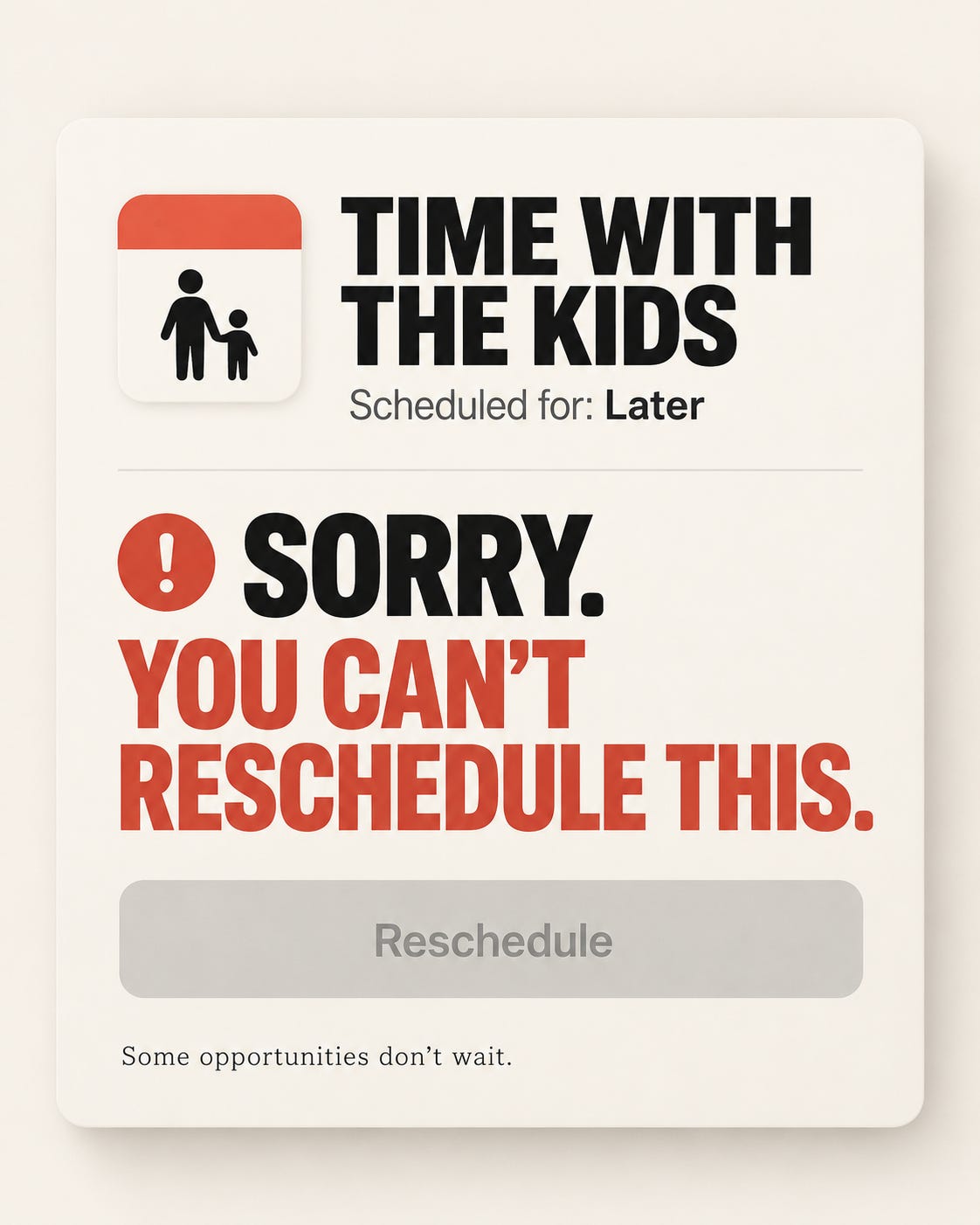
The practice that comes out of this is a single question, asked of anything you are putting off or saving for: who controls the deadline? If you can safely move it, waiting is a planning decision, and you can set the pace. If the deadline is set by someone else’s age, someone else’s needs, or your own health, then waiting is a bet that the opportunity will still be there. My grandfather made that bet about his health. He lost it, and the passports arrived anyway.
The passports
I think about my grandmother buying those holidays for her children. She had learned, in the hardest way, which deadlines belong to us and which do not, and she did not wait to pass the lesson on.
My grandmother passed away several years ago, but I stay in that timeshare every year. With my parents and my kids, all squished into one small apartment for one week every spring. It has become a week we return to year after year, accumulating memories across three generations. A gift born from the opportunity my grandfather never had.
Most of us are holding something like those passports: a trip, a conversation, a stretch of time with someone, that we have already decided to get to later. The decision usually feels responsible when we make it. My grandfather’s did too.
What are you saving for later, and is the deadline on it really yours?
Footnote
A preregistered replication published in 2022 found support for the pattern in several tests, although the effects were smaller than the original research suggested and one test failed to replicate it. A separate field study in 2023 also found that regrets about inaction became more prominent over time, although they did not constitute a clear majority of lifetime regrets.
To add to the story Dan...my mum & dad never got to stay at the timeshare resort either. I am so very happy that we use it every year...Iam very grateful they bought it, but very sad they didn't get to enjoy it.
Lovely piece of writing Dan....so glad lessons have been learned....by all of us. ❤️