

The first two essays in this series asked where the pressure behind burnout comes from. Part of the answer sat with the workplace, in the workload, friction, fragmentation and insecurity that can wear people down. Part of it sat with the person, in the standards capable people set for themselves, and how our achievement culture reinforces these standards.
The first essay suggested leaders should ‘clear the runway’ to ensure their teams can function without unnecessary constraints, but it does not tell us what to build once the runway is clear. This essay is my answer to that question, and it goes beyond the metrics of the report. The report recommends real support in place of perks, but it does not describe how to build that support in a team.
The answer has depth, so it comes in two parts. This first part covers what a leader gives a team: a purpose, and the freedom to act on it. The second part covers what that builds in people.
To answer this question, I’ve drawn on two principal resources, and the first is scientific research. Self-Determination Theory, developed over several decades by the psychologists Edward Deci and Richard Ryan, identifies three needs behind motivation and wellbeing: autonomy, competence and relatedness.1 Daniel Pink’s book Drive popularised similar ideas under the names autonomy, mastery and purpose. Put together, they give four things worth building into a team: autonomy, mastery, purpose and connection.
The second source is experience. The central idea in this essay is derived from centuries of military leadership theory, and was drilled into me from my first days of military training over 30 years ago.
The order of the four building blocks matters, and the order is my own reasoning, not a research finding. Purpose gives a team the context to act with autonomy. Autonomy creates not only agility, but also the opportunity to develop mastery, particularly when leaders coach rather than direct. Together, purpose, autonomy and mastery help create the conditions for connection.
Underneath all of it sits one shift in the leader’s role: from leading the plan and the work to leading the team through developing the plan and guiding the work.
Purpose: why we are here
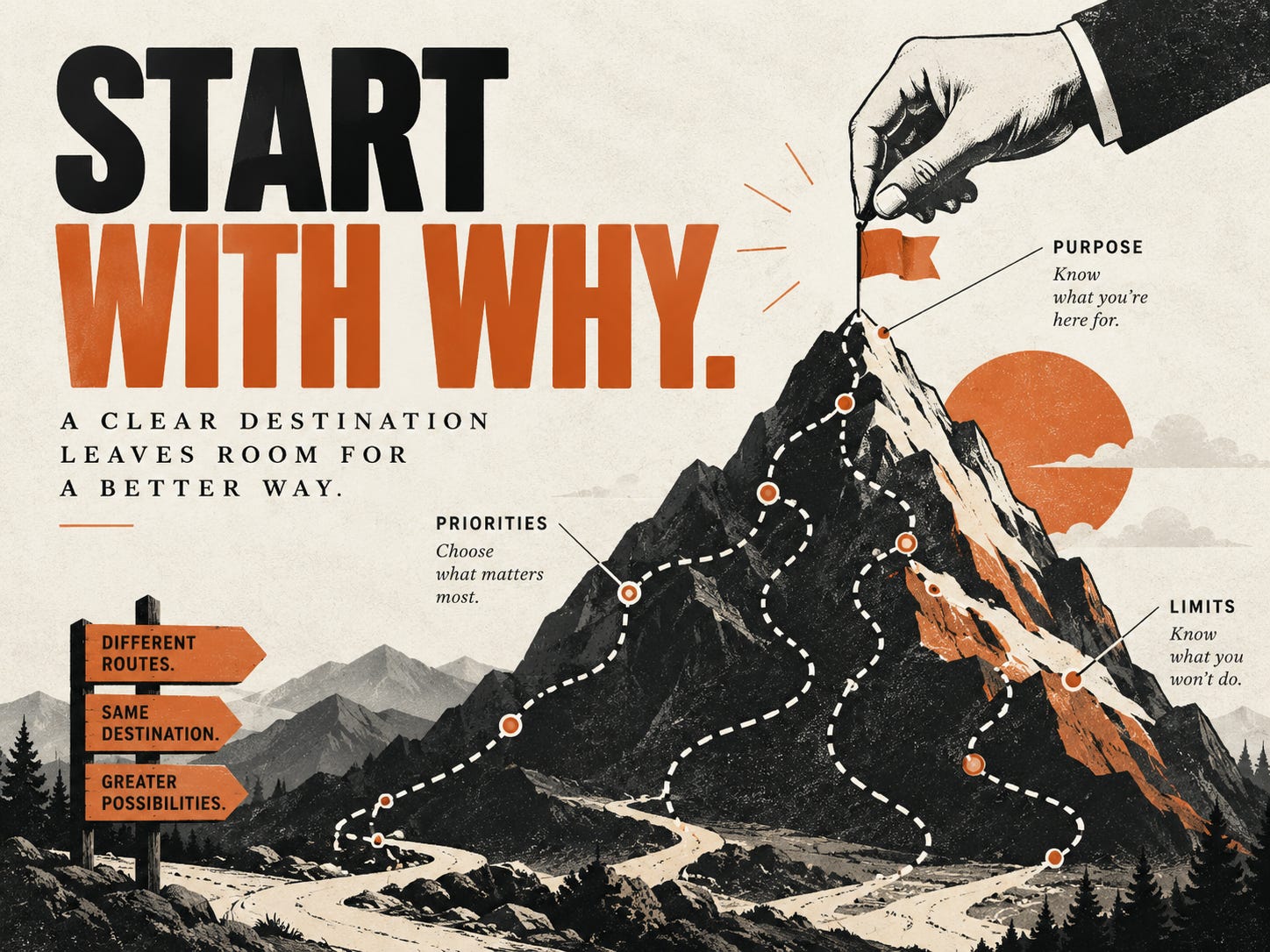
Purpose comes first because it makes the other three possible. Why are we here? Why are we doing this? A team that can genuinely and intuitively answer those questions can decide what matters, what to drop, and what to do when the plan stops working. A team that cannot has to wait to be told.
For the individual, purpose is the link between effort and meaning. If we can see what we contribute, we can be proud of it and pursue it. If we cannot, then our work risks becoming a burden. A meta-analysis by Blake Allan and colleagues, covering 44 studies and more than 23,000 people, found that people who see their work as meaningful report much higher engagement, commitment and job satisfaction, and moderately to strongly better life satisfaction and general health.2 Engagement matters for burnout in particular. Christina Maslach and Michael Leiter, whose work underpins the main measure of burnout, describe burnout as an erosion of engagement. People who find their work meaningful tend to be less burnt out.
The absence of purpose is easy to recognise. A team without it is rudderless. Effort goes into whatever is loudest and most urgent, people pull in different directions, and everyone waits to be told what matters.
For the organisation, the benefit of purpose is clear and understood priorities. When people understand the purpose of the team and of the work in front of them, they can rank that work, and they can re-rank it when the situation changes. Nobody has to wait for the leader to reprioritise. Priorities are the context autonomy depends on, because a team cannot be trusted to decide how to act unless it knows what matters most and why.
Cultivating purpose rests with the leader, but it works at several levels. The leader first makes sure each person understands their role in the organisation and what they bring to the wider environment, and then reinforces that through the work itself. When new work arrives, the leader explains why: what the work is for, and how its priority compares with everything else. The leader is also responsible for framing the endstate, which is what the finished work looks like and the condition that tells everyone the job is done. A simple test is to ask anyone on the team what matters most today and why. If the answers point in different directions, the purpose has not landed.
When people understand the purpose and the endstate, they can adjust their method as circumstances change. But they can only do that in an environment that gives them the autonomy to act.

Autonomy: freedom within a framework
Autonomy is important because of what control does for people’s wellbeing. Robert Karasek’s demand-control model, first set out in 1979, found that the combination that wears people down is high demands with little say over how to meet them. Decision latitude, meaning the authority to decide and the freedom to use one’s skills, separates a demanding job that stimulates from one that exhausts.3 The report’s findings are consistent with this. Difficult work did not separate burnt-out people from the rest. What did was the conditions around the work, such as friction and fragmentation, which take control of time and effort away from the person.
Autonomy also pays off for the organisation, in agility. Decisions are best made where the information is, because the people closest to the work see changes first. If every decision waits for the leader, the team ends up making reactive decisions after the situation has been briefed upward, and by then the situation has usually changed again. Purpose earns its place here. People can only decide well where the information is if they have the context to decide, and purpose and priorities are where that context comes from.
But equally, autonomy does not mean boundless freedom. It means freedom within a framework, together with accountability. In Self-Determination Theory, autonomy means acting with a sense of choice, and a sense of choice does not require the absence of structure. Without a clear why and clear limits, autonomy turns into drift.
Good autonomy is freedom within clear limits, with current context. Autonomy fails in two common ways. The first is micromanagement: when a leader specifies the method, the team can only comply, and the leader becomes the bottleneck for every question about how. The second is abandonment: with no limits and no context, the team drifts.
The framework rests on a deliberate distinction between accountability and responsibility. The leader is accountable for the outcome and retains the authority to approve the plan. The team is responsible for developing the plan and executing it, with the freedom to determine how the work is done.
This does not mean every decision requires the leader’s approval. Within the agreed boundaries and delegated authorities, the team makes its own decisions. The leader remains accountable for the outcome without taking responsibility for every decision about how to achieve it.
Two tools make the framework practical. The first is what the military calls the Commanders’ Critical Information Requirements (CCIR), a term for the information a leader has identified as critical to making timely decisions. In practice, the leader tells the team which events or numbers should bring them back to the leader. The events or numbers are the triggers, and they provide the frame for autonomy.
The second tool is a clear split between the authorities the leader retains and the ones the leader delegates. It clarifies which decisions the team and subordinate leaders can make. A simple version is a threshold: if the budget needs to rise by more than X, that is a decision for the leader, and below that limit the team decides. Both tools tell the team what it does not need to ask, and when it must.
The clearest sign of autonomy at work can be witnessed in how meetings run. In a team where the leader holds every decision, meetings exist to report status upward, and the team usually leaves with a laundry list of tasks to execute. In a team with autonomy, meetings trend toward ongoing communication. The main points of discussion are the changing situation and its context, shared in both directions; changes that need the leader’s decision authority; the delegation of resources; and the issues the team needs the leader to hear. Everything else the team can settle without the leader in the room. The meeting sets the direction of travel rather than producing a list of directed tasks.
Putting it to work: purpose, method and endstate
This idea has been around for a long time. In the military it is called mission command: the commander sets the intent, and subordinates decide how to achieve it. Mission command traces back to the Prussian army of the nineteenth century. A more contemporary example of the same idea is often called intent-based leadership, and David Marquet, a former US Navy submarine captain, popularised a related approach to intent-based leadership.
A simple way to conceptualise intent-based leadership is through three elements: Purpose, Method and Endstate. The leader gives the purpose, which is why the work matters. The leader also gives the endstate, which is the condition that tells everyone the job is done. The team works out the method.
The same split can be seen through the questions who, what, when, where, why and how. The leader owns the why and the what, together with the timeframe the work must meet. The team owns the how, and with it much of the who, the where and the sequence, within the limits the leader sets. The split holds through both planning and execution.
In planning, the leader gives the purpose, the endstate, the priorities, the limits and the thresholds. The team designs the method and presents it back, which the military calls a back-brief: how the team intends to achieve the endstate, and what resources it needs. The leader approves the plan, adjusts the limits or provides what is missing. The plan is the result of the team’s work under the leader’s guidance, and the leader remains accountable for the plan and its execution.
In execution, the team carries out the plan and makes the decisions that sit inside the agreed thresholds. When a trigger is reached, or the situation changes enough to matter, the team goes back to the leader with the change and a recommendation, and the leader decides what only the leader can decide. Marquet even recommends the team raise issues and proposed solutions by explaining the issue and then stating ‘I intend to…’ with their recommended response. This subtle use of language continues to ensure the team has ownership over the problems and solutions, and the leader is endorsing them (or intervening if necessary).
The leader’s discipline matters in both phases. A leader who uses the back-brief to rewrite the plan has taken the method back, and the meeting becomes the same oversight ritual under a new name.
Give the why, ask for the how
The benefits of this approach are not limited to better decisions or a more responsive team. It changes the experience of doing the work. People are given greater control over how they meet their responsibilities, rather than waiting for instructions at every step. They know what matters, understand the limits of their authority and can use their judgement. That does not remove excessive workloads or guarantee protection against burnout. But it addresses one of the conditions that can make demanding work unnecessarily stressful: having responsibility without meaningful control.
Putting intent-based leadership into practice is simple, but often uncomfortable. Next time you hand over work, give the purpose, the endstate, the priorities, the limits and the thresholds, and ask the team to come back with the method. Then keep the context current, so the team hears about a change from you before they have to find it out.
Handing over the ‘how’ can sit uncomfortably with a leader, and it should. The team will not always plan the way you would have, and sometimes the plan will be weaker than your own. You are handing over control while remaining accountable, and the discomfort is part of the practice. Leaders who hold on to control can compromise agility, efficiency and the development of their team.
But the back-brief is how a leader manages the discomfort: seeing the plan before work begins, asking questions, adjusting the limits and providing what is missing, while the team maintains ownership and autonomy. If handing over the how feels uncomfortable, you are probably doing it right.
The next article looks at what handing over the how builds in the people who receive it. For now, one question: what do you do when your team’s plan is not the plan you would have made?
Footnotes
Gagné, M. and Deci, E. L. (2005). Self-determination theory and work motivation. Journal of Organizational Behavior, 26(4), 331-362.
Allan, B. A., Batz-Barbarich, C., Sterling, H. M. and Tay, L. (2019). Outcomes of meaningful work: A meta-analysis. Journal of Management Studies, 56(3), 500-528.
Karasek, R. A. (1979). Job demands, job decision latitude, and mental strain: Implications for job redesign. Administrative Science Quarterly, 24, 285-308.