

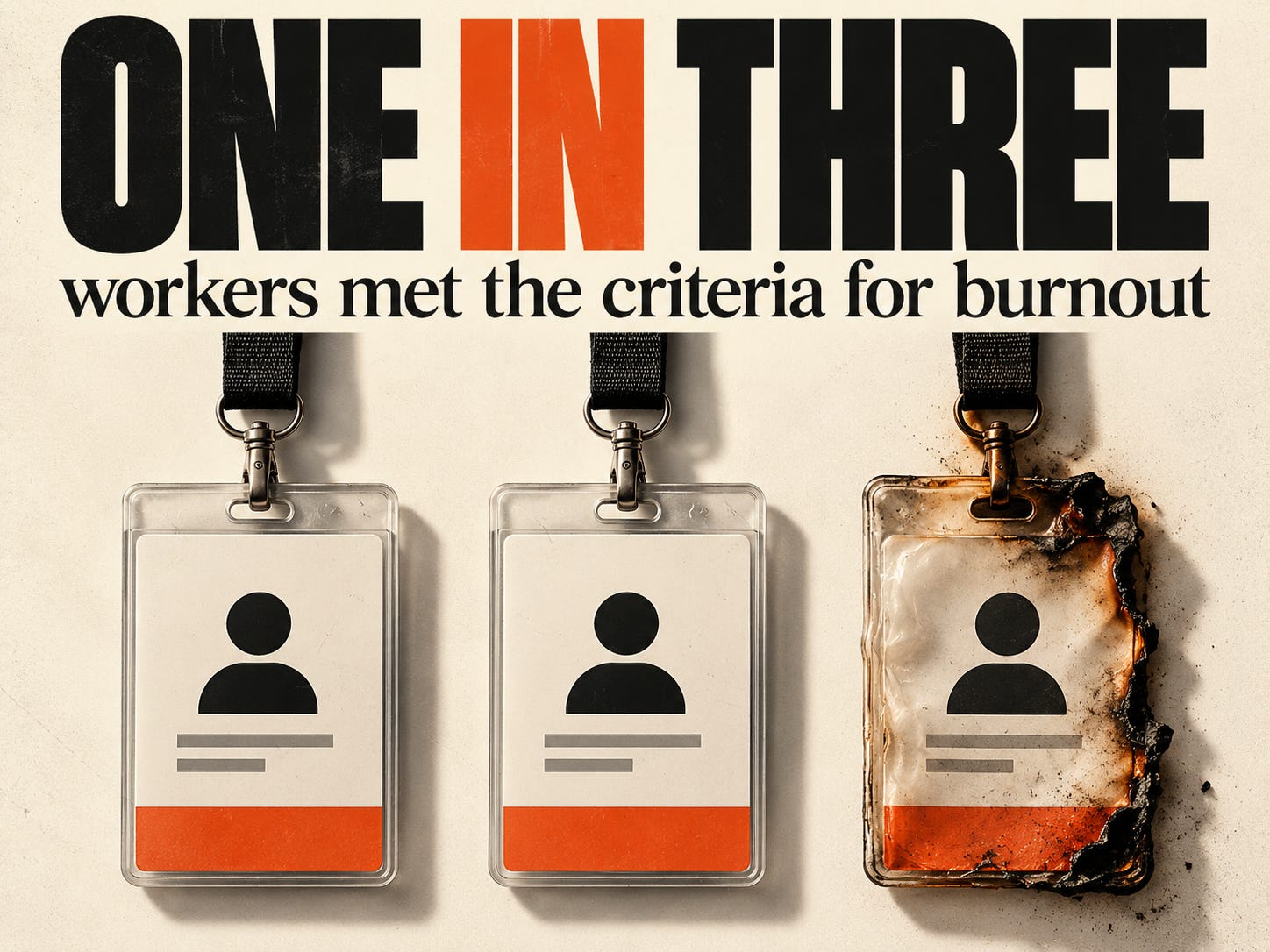
More than one in three workers is burnt out, and according to a new international report, how work is organised can matter as much as how demanding the work is.
The State of Workplace Burnout 2026 was produced by the research group Infinite Potential, with Beyond Blue and the Ultimo Institute at the University of Technology Sydney. The survey covered 1,815 workers across 12 countries, and 36 per cent of them met the full definition of burnout.
The definition matters and it comes from the World Health Organization and requires three things together: exhaustion, cynicism or distance from the job, and a reduced sense of being effective at work. Feeling tired or stressed does not equate to burnout. A person who is tired, detached and doubting their own effectiveness does. More than one in three workers surveyed met the criteria for burnout. If this sample were taken as representative then a team of three includes about one person who meets the definition, and a team of five about two.
And the problem is not new or passing. Across the six surveys since 2020, the rate has stayed between 30 and 38 per cent, and the report treats burnout as a stable feature of work. Our position in the organisation offered no protection either. Job level made no significant difference, so executives and people leaders were no safer than anyone else.
However, the average hides a more important finding. Burnout ranged from 14 per cent among the best-supported employees to 66 per cent among the least supported. The same survey and the same definition produced a gap of nearly five times. Burnout is not spread evenly across the people surveyed. It is far more common among employees who feel poorly supported, and many of the conditions associated with it are things leaders can influence. That gives leaders a clear place to start. So what is causing such high levels of burnout in the workplace?
It is not the hard work
The obvious suspect is the work itself, so the report tested it. The report separates three kinds of mental demand that feel equally tiring. The first is necessary challenge: complex cases, difficult decisions and work that needs long concentration. People carrying more of it were not significantly more likely to be burnt out.
Difficulty and volume are different things. The report found no significant increase in burnout among people carrying harder thinking, but a clear link between burnout and the amount of work. The report asked how many hours people worked beyond their scheduled week, which separates the extra load from the contracted one. Burnout rose by 22 points across the range, from people working up to three extra hours a week to those working sixteen to twenty-four. Overall wellbeing fell by 12 points, and the share of people feeling lonely at work rose by 31 points.
Pace points the same way. Of the people surveyed, 74 per cent finished a typical workday mentally and emotionally exhausted, 54 per cent struggled to keep up with the pace and volume of work expected of them, and only 33 per cent had enough energy left for life outside work.
Workload is a leadership decision and leaders can do a few simple things to help their teams:
Accept that we will almost always have more work than time or capacity. If this wasn’t the case, burnout wouldn’t be as big an issue.
Set clear priorities of work based on the purpose of the team and mission at the time. Your team exists for a reason so focus on that reason.
When new work arrives, something else may need to stop, wait or be resourced differently. Leaders should make those trade-offs explicit rather than expecting their teams to absorb every additional demand.
Where the work exceeds available capacity, leaders have a responsibility to explain the risks to their superiors: what can be delivered, what cannot, and what additional resources or decisions are required.
Nobody can do all of the work all of the time, and developing a sustainable pattern of work keeps trained and experienced people in the organisation, who are slow and expensive to replace.
Friction: the work about the work
The second kind of demand is system friction: broken systems, duplicated work, unclear instructions, chasing information and unnecessary approvals. The report links friction to 74 per cent higher odds of burnout.
Odds compare how likely burnout is in one group against another, so 74 per cent higher odds does not mean 74 per cent more people are burnt out. The figure means burnout is clearly more likely among people fighting the system than among people who are not.
A second figure shows how common friction is. Of the people surveyed, 71 per cent said they work around poorly designed systems to do their job. For most workers, friction is the normal condition of the working day, and the effort spent getting around it adds nothing to the work. People can work around a broken system. Only someone with the authority to change it can fix it.
Finding out is the first step. Ask your people what repeatedly makes their work harder than it needs to be. Identify the biggest obstacle, whether it is an approval process, a broken system or an unclear responsibility, and take ownership of getting it fixed. Then ask whether the change actually made their work easier.
Do you know where the biggest point of friction is in your team?
Fragmentation: the day that never lets you focus
The third kind of demand is fragmentation: constant messages, interruptions, task switching and too many competing decisions. Fragmentation carried 53 per cent higher odds. Constant meetings, messages and interruptions are standard examples of fragmentation, and each switch forces the person to rebuild their focus afterwards.
Fragmentation costs twice: once for the time spent in the meeting or the message, and again for the time spent getting back into the work. Calendar and communication habits are set largely by leaders, and teams copy them.
Leaders can help their teams by limiting how many priorities the team carries at once (this also helps with workload), and by protecting blocks of time with no meetings or messages.
Teams also need clear expectations about communication: what requires an immediate response, what can wait, and when people should be left uninterrupted to complete their work.
Then consider recurring meetings. For each one, ask who decides or does something differently because the meeting took place. A meeting with no answer is a candidate for removal or replacement.
Insecurity: not knowing whether the job is safe
Job security produced one of the widest gaps in the report. Among people who felt not at all secure in their jobs, 63 per cent met the definition of burnout. Among people who felt very secure, 18 per cent did. The groups in between declined steadily: 50 per cent for the somewhat insecure, 41 per cent for those who were not sure, and 27 per cent for the somewhat secure.
Leaders cannot always offer security. Restructures, funding decisions and market conditions are often outside a team leader’s hands. What leaders can control is how much people are left to guess.
Treating our people with respect and saying what is known, what is not yet known, when decisions will be made is fundamental to a culture of trust. The report calls this a no-surprises standard. The standard does not promise security, but it ends the guessing.

Clear the runway
The report gives leaders four places to look: workload, friction, fragmentation and insecurity. Each asks different things of a leader, yet they are built upon a single principle of leadership.
At its simplest, a leader’s job is to care for the people in their team. That means paying attention not only to what they deliver, but to what the work demands of them and how it affects their lives. Good leaders don’t respond to every problem by asking for more effort. They clear the runway. Clearing the runway is removing the broken process, the meeting nobody needed, the competing priorities no one has resolved, and the uncertainty nobody has explained. Remove those obstacles, and people can put their effort into the work itself rather than struggling against the conditions around it.
The value of this report is not just in highlighting how prevalent burnout is in the workplace, but how significant a leader can be in shaping it. Recall the gap from the start of this essay: burnout was 14 per cent among the best-supported employees and 66 per cent among the least supported. That is about one person in seven, against two in three. In this survey, those who felt most supported were also the least likely to meet the burnout criteria.
Perks such as fruit bowls and gym memberships are cheap, gimmicky stand-ins for actually caring. The report is blunt that perks are no substitute for support that changes the work. A leader who wants to lead has to roll up their sleeves, find the issues and start to clear them out.
The people the system does not explain
But not all blame for burnout can be attributed to leadership. The same data also holds a figure that leadership and work conditions alone do not obviously explain. Among workers who described themselves as somewhat satisfied with their jobs, 25 per cent met the definition of burnout. Among the extremely satisfied, 8 per cent did. The report calls the pattern performance masking: burnout also affects people who say they like their work.
Yet one finding complicates this picture. Among workers who described themselves as somewhat satisfied with their jobs, 25 per cent still met the definition of burnout. Even among those who were extremely satisfied, eight per cent did. People can enjoy their work, feel committed to it, and still be burnt out.
That is not evidence that their working conditions were good, or that leaders had done everything they could. Job satisfaction and a healthy working environment are not the same thing.
But it raises another question that this report cannot answer. Beyond the demands organisations place on us, what demands do we place on ourselves? Why do capable, committed people sometimes keep pushing beyond their limits, even when nobody is explicitly asking them to?
That’s the question I’ll explore next week.
Source: Infinite Potential, The State of Workplace Burnout 2026 (Dr John Chan), with Beyond Blue and the Ultimo Institute, UTS. https://infinite-potential.com.au/the-state-of-burnout-2026
Footnote:
These are alarming figures, however it is important to note the report has limits. The survey is cross-sectional, so its findings are associations and do not show cause. The sample size is relatively low, and Infinite Potential also offers services to organisations, so it has an interest in the conclusion that organisations should change. None of these points makes the data wrong, but they should be factored into our considerations.